

“There are no bad parts.”
– Dr. Richard Schwartz
Internal Family Systems (IFS), a form of parts work, helps us understand the different aspects of ourselves – not as problems to fix, but as protectors shaped by past experience. Rather than fighting against these parts, IFS is an approach that invites us to listen, to understand, and to lead with self-compassion.
You know when you’re in a close relationship, conflict arises, and you find yourself saying or doing something you know will make things worse, and yet, you can’t stop yourself. From an IFS perspective, this isn’t a failure of willpower; it’s the activation of different parts within the system.
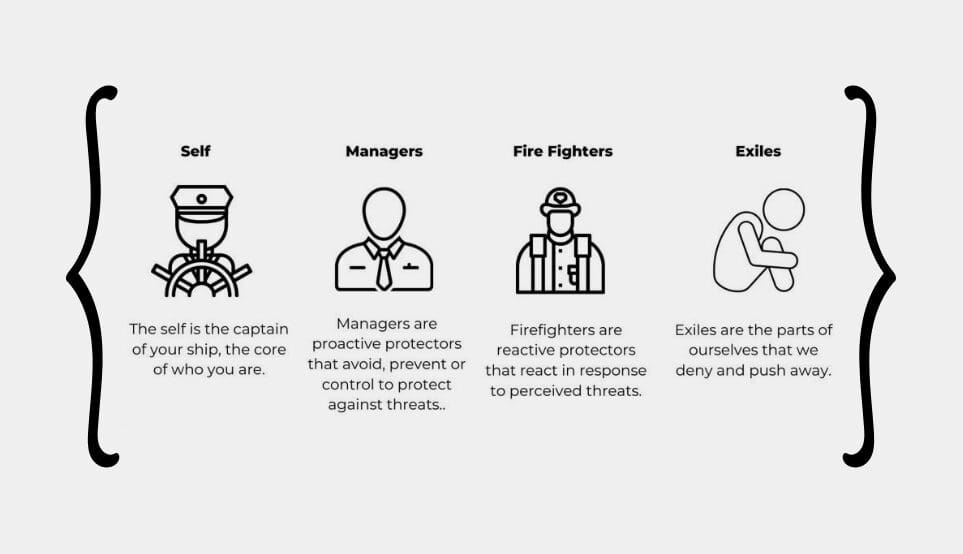
So, What Are Parts? IFS classifies parts into four main categories:
The parts of us that carry pain
We all have what Schwartz calls “exiles” – often younger, more vulnerable parts of us that carry the imprint of past hurt or trauma.
Before these parts were hurt, they held qualities like openness, curiosity, creativity, and playfulness. But because they are also the most sensitive, they are often the parts that are wounded most deeply.
When overwhelming experiences occur, these parts take on what IFS calls burdens – intense emotional imprints that can feel frozen in time. When activated, they can pull us back into those earlier states, flooding the system with feeling.
In response, it’s natural to want to push these parts away, to move on, to leave the past behind, without realising that, in doing so, we may also be distancing ourselves from some of our most vital and alive qualities.
When protective survival strategies begin to hold us back
As these vulnerable parts become more hidden, other parts of the system step in to protect. In IFS, these are known as protectors, and they tend to organise themselves in two main ways:
Managers work to keep life controlled and predictable, often through high functioning, perfectionism, or constant vigilance, in an attempt to prevent the exiled pain from being triggered.
Firefighters, on the other hand, respond when something has already been activated. They can be more reactive or impulsive, seeking to quickly soothe, numb, or distract from overwhelming emotion, sometimes without regard for longer-term consequences.
While these strategies can feel frustrating or self-defeating, they are, at their core, intelligent attempts to protect the system from pain that once felt unmanageable.
The important role of the “Self” in healing
One of the central ideas in Internal Family Systems is that beneath these parts, there is an essential core – what Schwartz calls the Self (with a capital “S”). This Self is not another part. It is the aspect of us that is naturally curious, compassionate, and capable of presence.
When clients begin to access this state, they often describe it not as something foreign, but as something familiar, a sense of “this is me.”
From this place, there is an innate capacity to begin relating to wounded parts differently, not with judgement or urgency, but with understanding.
IFS suggests that this Self is always present. It cannot be damaged, and it holds an intrinsic ability to support healing, once there is enough space for it to emerge.
The 8C’s of IFS Curiosity, Compassion, Clarity, Connectedness, Creativity, Confidence and Calm. And the 5 P’s of IFS are Patience, Presence, Persistence, Perspective and Playfulness.

A different way of relating to yourself
Parts work offers a shift away from trying to override or eliminate certain aspects of ourselves, and instead moves toward developing a healthier relationship with them.
Over time, as these parts feel more understood and less burdened by the past, they can begin to soften and return to their more natural, valuable states.
This is where change tends to happen – not through force, but through understanding, contact, and the experience of something different.
If you’re longing to reconnect with your true self, make peace with how your parts have adapted, and gently support them to release old burdens and find healthier ways of relating, you’re warmly invited to explore one-on-one counselling or keep an eye out for upcoming group offerings. I offer a blended, integrative approach to therapy that is informed by Internal Family Systems (IFS) or parts work as a way of gently working with the dissociation that can follow early life trauma and relational ruptures. I will always respond to what feels most supportive and useful for each person.
These blogs are intended as an educational resource, not medical advice, and do not replace the care and nuance of individual therapy.
Further resources on Parts Work & IFS
- No Bad Parts — Dr. Richard Schwartz
- You Are The One You’ve Been Waiting For — Dr. Richard Schwartz
- The Ordinary Sacred | Christine Nixon (YouTube & Instagram)
image credits | feet unknown | mentallyfitpro.com | hands unknown